Building Formality in Morocco’s Metal Recycling Sector. Lessons from MCF.
This case study was researched and authored by Hajar El Jahidi, edited by Faatimah Clarke and Ilaria Blasi.
We acknowledge with gratitude the contributions of Morocco Copper Foundry and the young participants whose insights, interviews, and reflections informed the analysis presented here.
MCF’s experience raised three central questions about what it takes to build a formal business in an informal sector:
- How can a formal recycler stay competitive when much of its supply chain does not operate formally?
- What would make collectors and intermediaries choose traceability rather than avoid it?
- And what happens when regulation asks formal companies to comply, while the wider market is not held to the same standard?
This study will try to address them.
An Industrial Sector Between Formality and Informality
Morocco’s scrap metal processing sector remains highly informal. Copper scrap moves through a dense ecosystem of collectors, intermediaries, traders, wholesalers, exporters and recyclers, where transactions are often relationship-based, fast-moving, and only partially documented. For many workers and small actors, this ecosystem provides income, flexibility and access to opportunity, but it also creates challenges around working conditions, traceability, social protection, and formal job creation.
Morocco Copper Foundry (MCF) entered the sector against this backdrop. The company was built around a simple industrial proposition: collect copper scrap, process it locally, and supply Moroccan industry with local productsrather than allowing more value to leave the country through limited-transformation exports.
The logic was aligned with several national priorities at once. Copper is used in construction, infrastructure, energy, electrical equipment, and manufacturing. Recycling can reduce reliance on imported raw material, retain more industrial value domestically, and create formal employment in a sector where informality remains widespread.
MCF’s experience shows that demand for copper is only one part of the business case. The decisive issue is access to scraps that a formal company can buy legally, predictably, and at viable prices.
The factory could control what happened inside its gates. It could invest in equipment, recruit workers, set safety rules, introduce traceability tools, train teams, and document production. What it could not control in the same way was the market feeding the factory.
That market had its own routines. Material moved quickly, often through personal relationships and cash-based transactions. Documentation was uneven, but the system was not necessarily experienced by those involved as disorganised. For many actors in the chain, it was the way they earned, negotiated, managed risk, and responded to opportunities.
For MCF, however, the same system created a constraint. The company needed copper scrap in sufficient volume, at a viable price, and through channels it could legally use. It also needed to know where the material came from, who handled it, and whether it could be purchased without legal or reputational risk.
That tension sits at the centre of the case. MCF’s journey shows what happens when a formal business enters a market where informality remains commercially useful, socially embedded and, for many actors, more attractive than the formal alternative.
Building a Formal Business in an Informal Ecosystem
MCF is an implementing partner of the Challenge Fund for Youth Employment (CFYE), which supports private-sector initiatives to create, match, and improve decent jobs for young people. In MCF’s case, CFYE’s support helped connect the industrial project to a wider employment and inclusion agenda: the transition from informal to formal work, safer working conditions, access to training, women’s participation and more structured employment pathways in a sector where many activities remain informal or semi-formal. This was particularly relevant because MCF’s challenge was not only to build a factory, but also to create trusted and credible employment pathways for young men and women with limited access to formal opportunities in the sector.
MCF’s next challenge was operational. The company had to turn the industrial proposition into a functioning production system: sorting and treatment facilities, traceability tools, management software, quality controls, written procedures and, just as importantly, a workforce capable of operating in a new industrial environment.
The workforce dimension came early. There was no large pool of workers in Youssoufia with direct experience in copper recycling. MCF therefore worked with ANAPEC1 and training partners2 to identify candidates and prepare them for factory work.
Several employees described the early period not as joining a finished operation, but as helping build one.
“We didn’t just join a factory. We helped install one.”
Workers were not simply absorbed into an existing labour market; they were trained while the activity itself was taking shape. They had to learn technical tasks, safety rules, production discipline, supervision routines, and the expectations of a formal industrial workplace.For many, this was their first experience in this kind of setting.
ANAPEC and management both pointed to the same recruitment reality: technical qualifications were not enough. The company needed people who could learn, show up consistently, follow safety instructions, and adapt as the operation changed.
As one ANAPEC representative put it: “Motivation is 70%.”
MCF was therefore building the skills base that made the factory possible, not simply filling vacancies.
Inside the factory, the formal model began to take shape. Workers were trained. Production routines became more structured. Traceability and documentation systems were introduced. Safety and quality standards were reinforced. The company could increasingly define how work was done within its own perimeter.
Then came the constraint that management kept returning to: raw material, which makes up 80% of the entire business.
That figure changes the way the case should be read. MCF’s main vulnerability was not only operational, it was also commercial. The factory depended on regular access to copper scrap, in sufficient volume, at a price that allowed production to remain viable.
The material existed. Collectors and intermediaries were active. They knew where to find scrap, how to sort it, how to move it, and who would buy it. In many ways, the informal market was already doing the practical work of a supply chain. But the problem was not the absence of supply; it was the way it moved.For collectors and intermediaries, the existing system offered speed, flexibility, cash flow, and room to negotiate. For MCF, it offered volume but not always the visibility, paperwork or assurance required by a formal industrial actor.
That is where the limit of factory-level formality became visible. MCF could organise its workforce and document its production. It could not, by itself, formalise the market from which it sourced.
The company therefore faced a sourcing question that would shape the rest of the case: how far could MCF secure the material it needed while maintaining the traceability requirements that made the business formal in the first place?
Formalisation Beyond Compliance
MCF first looked to the cooperative model as a way to organise the collection side of the value chain. The idea on paper made sense. A cooperative could bring collectors closer to the formal system without turning them into factory employees. It could help identify suppliers, improve working conditions, introduce safer sorting practices, and create a more regular supply channel.
But the cooperative experience also revealed the central weakness of many formalisation efforts: a legal structure is not the same thing as an incentive.
Before Youssoufia, MCF tested a more direct approach in Meknes. The company identified a group of collectors, organiseorganised awareness sessions, supported training and tried to bring them into a cooperative. The collectors, however, did not join.
The reasons were not superficial. Interviews pointed to mistrust, fear of becoming visible to the administration, reluctance to sign legal commitments, pressure from intermediaries, and limited support from public authorities. Collectors had been approached. Some had been informed and trained. But the formal option still did not look attractive enough compared to the system they already knew.
When MCF later moved to Youssoufia, it adjusted. Instead of trying to formalise individual collectors from the start, the company worked through selected intermediaries, local relationships, and discussions with public authorities around sector rules. It was less direct than the original ambition, but probably more realistic.
From MCF’s perspective, traceability was non-negotiable. The company could not buy copper scrap without knowing where it came from. It needed supplier identification, identity documents, transport records, and some assurance that the material was not stolen. For collectors, the same requirements looked different. Being identified did not automatically mean being included in a better system, rather, it meant becoming visible. Visibility could mean taxes, controls, paperwork, loss of autonomy or problems with institutions they did not trust.
The collector interview showed how organised the informal system can be in practice. Collectors and intermediaries know where to find scrap, how to move it, how to sort it, and who will buy it, which all depends on relationships, experience, and local knowledge. In some families and communities, it is learned over time and passed from one generation to the next.
“It passes from father to son.”
The question, then, is not only why collectors avoid formalisation. It is what they would gain from it.
The informal system offers things that matter: flexible time, fast payment, several possible buyers, little paperwork and sometimes better earnings than a factory job. One collector was blunt: “They make more money in scrap than in a factory.”
Joining a cooperative can therefore look like a loss before it looks like an opportunity. A collector may give up autonomy, discretion, bargaining power, and income potential. Unless the formal option compensates for those losses, it will feel like control rather than inclusion.
That is the weak point of the cooperative model. The structure can exist. The value proposition may still be missing.
What does a collector gain by joining? More predictable income? Better prices? Safer working conditions? Equipment? Access to a reliable buyer? Protection from price swings? Simpler paperwork? Some form of social protection?
Without something concrete, formalisation remains an administrative request made to people who already have a functioning livelihood system.
Intermediaries complicate the picture further. They are often described as blockers because they stand between collectors and formal recyclers. But they also perform real functions. They aggregate volumes, manage quality differences, organise transport, maintain relationships with collectors, and react quickly when prices move.
The formal system has not yet replaced those functions. That is why MCF continues to rely on selected intermediaries, even though direct sourcing formed part of the original ambition.
We could argue that while this is not yet full formalisation, it is, however, a negotiated step toward it.
For MCF, the practical lesson is clear: formalisation cannot be treated as compliance alone. Collectors and intermediaries will not move toward traceability simply because a formal company needs them to. They will move if the arrangement gives them enough in return.
Regulation as Both Enabler and Constraint
MCF needs regulation. Its model depends on a recycling sector where materials can be traced, suppliers can be identified, and basic environmental and labour rules are applied.
The problem isn’t the existence of rules as much as an uneven application of the existing rules. A formal recycler must comply with traceability, environmental, labour and administrative requirements. Parts of the surrounding market continue to operate with far less visibility. This creates a difficult position for companies like MCF: they are aligned with the policy direction, but they may carry higher costs than actors operating outside the same framework.
The sector is large enough for this to matter beyond one company. Estimates put Morocco’s annual metal waste at around 70,000 tonnes of non-ferrous waste and 700,000 tonnes of ferrous waste, with an estimated market value of 3.1 billion MAD. Far from being a marginal activity, it is a commercial chain with real value, several layers of actors and strong incentives. But it is also hard to regulate.
Material passes through individual collectors, intermediaries, wholesalers, exporters, and formal recyclers. Each actor does something useful. Collectors find the material. Intermediaries aggregate it. Others sort, transport, store, sell or export it. But the transaction trail is often incomplete, especially at the early stages.
For MCF, this creates a sourcing dilemma. Copper scrap has value. It is easy to resell. It can also be stolen and reintroduced into the market. Traceability requirements are therefore necessary. The company needs to know who supplied the material, how it was transported, and whether it can be purchased legally.
Those same requirements also limit who MCF can buy from.
The factory cannot simply purchase from anyone who arrives with copper scrap. It needs documents, supplier identification, transport records, and some assurance that the material is clean. These requirements protect the company, but they also make sourcing harder in a market where much of the material still moves informally.
That is the imbalance management kept identifying. Formal companies comply but less formal actors can often move faster, pay differently, buy more flexibly and avoid part of the cost of compliance.
One management interviewee put it sharply: “The informal wants to kill the formal.”
While this is a management view, and not necessarily a neutral description of the whole sector, it gives a tangible sense of the pressure felt by the company. MCF is being asked to operate formally in a market where not everyone is playing by the same rules.
The imbalance is also visible in the distribution of value. According to the market study, collectors capture around 4% of ecosystem turnover, while intermediaries capture 39% and wholesalers 57%. The people most often targeted in formalisation discussions are therefore not necessarily the people with the most market power.
That matters for policy design. If collectors are asked to become visible, traceable, and administratively compliant while remaining at the bottom of the value chain, they may see more obligations without much additional gain. Meanwhile, actors higher up the chain may have little reason to change if the current system already works for them.
Rules alone will not shift that.
Enforcement is also politically sensitive. Scrap collection supports livelihoods, including in vulnerable communities. Authorities may hesitate to enforce rules abruptly if this threatens income or creates local resistance.
The issue sits between industrial policy, enforcement capacity, informal work, and the need to create alternatives that people can actually use.
Export restrictions add another layer.
For a domestic recycler, limiting copper scrap exports can help. More material stays in Morocco, and local transformation becomes more realistic. MCF benefits from that direction. A domestic recycling industry cannot grow if the raw material base is constantly pulled toward export markets. But keeping scrap in the country does not automatically solve the problem.
If the material remains in Morocco but continues to circulate through informal or poorly documented channels, MCF may still struggle to access it legally and predictably. The issue thus is whether the material moves through channels a formal company can use rather than is the material leaving Morocco.
That is why MCF’s engagement with public institutions and professional bodies matters. The company has pushed for clearer rules on collection, transport, storage, sorting and recycling of non-ferrous scrap. These efforts are not separate from the business. They are part of the business case.
We cannot assume that Morocco lacks regulatory ambition. The question is whether regulation changes behaviour across the chain. For companies like MCF, regulation helps only if it creates a more level field: clearer sourcing channels, consistent enforcement and traceability systems simple enough for the chain to use.
Otherwise, formal companies carry the costs of compliance while competing in a market that still rewards informality.
Professionalising the Sector
The difficulties around sourcing, formalisation, and regulation do not cancel out what MCF has already changed.
The company has introduced a more structured way of working in a sector where many activities have traditionally been informal or only partly formal. And while it is not yet a full transformation of the sector, it is still professionalisation within the company’s immediate area of control.
That change starts in the factory.
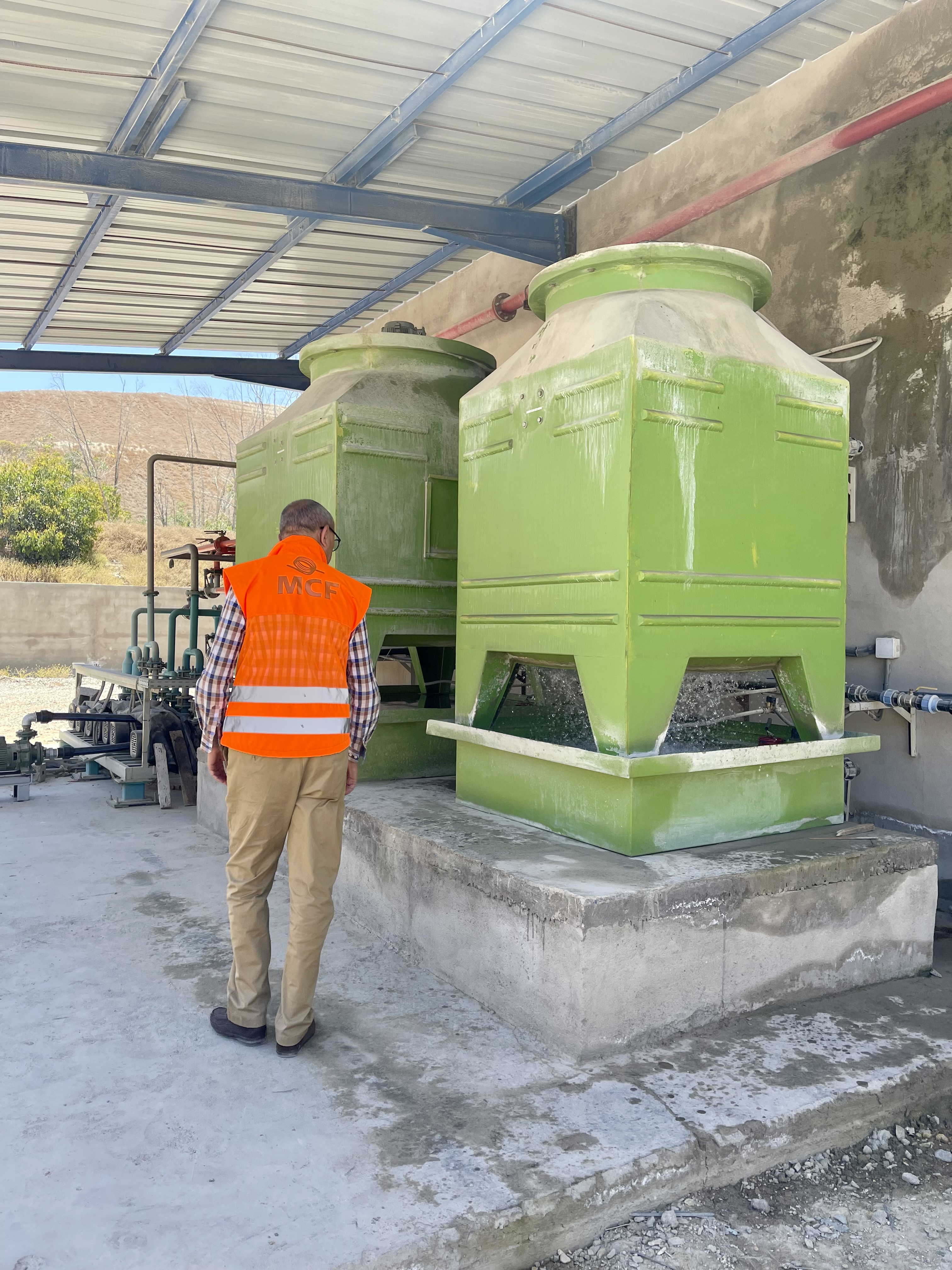
Copper waste entering the facility is received, checked, weighed, labelled by type, sorted, separated, processed, and stored through defined steps. Manual triage, electrostatic separation, baling, quality checks, and the refusal of unsuitable waste are operational routines. But they also signal a shift in standards. Scrap is no longer simply moved and resold, but ratherhandled through a documented industrial process.
Professionalisation is built through repetition: workers learn procedures, supervisors enforce them, documents are filled, quality is checked, and safety rules become part of the daily rhythm.
Employment is part of that shift.
With ANAPEC and training partner (Mohammed VI Polytechnic University), MCF created entry points into a new industrial activity for workers with different backgrounds: first-time jobseekers, people with informal work experience and workers looking for more stable employment. ANAPEC’s role was not only to send candidates,it also helped prepare them for a workplace where concentration, discipline, safety, and adaptability mattered.
Employees described the training as useful because it reduced the distance between the classroom and the factory.
“What we saw in training, we found here.”
That matters in a city where this kind of industrial activity did not previously offer a ready-made employment path. Training did not only improve individual employability; it helped make the activity possible in Youssoufia.
For some workers, formal employment also changed their relationship to work. It brought social protection, predictable income, clearer responsibilities, and a professional identity. In a local context where many young people look elsewhere for opportunity, the presence of a formal industrial employer has visibility.
One employee summarised it simply:
“MCF is fighting unemployment at its own scale.”
The scale should not be overstated. MCF alone cannot transform the local labour market. But stable industrial jobs are noticed. Employees spoke about friends, neighbours and young people asking how to apply or where to submit CVs. The factory became a visible route into work.
The local dimension matters here. As one ANAPEC representative puts it: “Each territory lives and breathes in its own way.” In Youssoufia, a job is not only a salary. It can influence whether a young person stays or leaves, whether transport is manageable, whether family life is disrupted, and whether people believe the territory can offer a future. The worker trajectories make this concrete.
A 28-year-old maintenance electrician from Youssoufia joined MCF after running a small home-appliance shop and taking informal repair jobs when work was available. He arrived while the factory was still being installed. The job gave him more than income. It gave him an industrial skillset close to home, in a field connected to a new recycling value chain.
Another worker, previously self-employed in camera installation, moved from irregular assignments into furnace operations. The difference was not only stability. It was the accumulation of career capital: routines, references, technical exposure, teamwork, and a clearer professional identity.
The gender findings are more cautious. MCF is not yet a major gender inclusion transformation story.
Women’s participation at site level remains limited. Barriers persist around technical training pathways, social norms, transport, perceptions of heavy industry and family acceptance.
Still, the women who joined MCF show what can make participation possible. Location matters. A job in Youssoufia can be easier for families to accept than a job in another city. Suitable roles matter. Safety and transport matter. Visible examples of women already working on site matter.
A 24-year-old woman who had worked as an accountant in Rabat returned to Youssoufia and joined MCF. Her trajectory shows how proximity can change the social equation. Because the job was local, it became easier for her family to accept. The employer was known, the distance manageable and the work part of a local routine rather than a move away from home.
Her story does not erase the barriers women face in heavy industry, but it shows that the same industrial opportunity can be perceived differently when it is close to home, connected to a known employer and made visible through women already present on site.
As one woman described it, working for her meant:
“Stability, independence, confidence, dignity, and a future.”
That is where MCF’s contribution is strongest. The company is not only processing copper, it is also showing what a more structured recycling activity can look like: trained workers, formal contracts, traceability tools, ERP systems, safety routines, quality controls and documented procedures.
Under the CFYE project, MCF received targeted technical assistance (TA) to address these issues. Support included a gender diagnostic, workshops on inclusive governance, recruitment, working conditions and workplace culture, and the co-creation of a comprehensive Gender Action Plan with practical HR, reporting and training tools. As a result, MCF initiated more inclusive HR and procurement processes, improved workplace facilities and conditions for women, and embedded a clear roadmap for integrating gender into governance and organisational culture, demonstrating that even heavy industry can successfully adopt gender-inclusive practices and serve as a model for the sector nationally. The wider ecosystem will take longer to change. But professionalisation has already started inside the factory. That matters for workers, local institutions and the recycling sector more broadly.
For CFYE and other employment actors, the value of a job lies in the experience built around it: the routines workers learn, the skills they develop, the standards they are exposed to, and the resilience of the business model behind the position.
Lessons and Future Pathways
MCF’s experience points to four practical implications.
The first is for MCF: build traceability through selected relationships, not abstract formalisation.
The failed Meknes cooperative pilot showed that collectors will not enter a formal structure simply because it exists. MCF’s more realistic pathway is likely to be gradual: trusted intermediaries, clearer supplier expectations, repeated transactions, better documentation and commercial arrangements that make traceability worth accepting. Direct formalisation may remain an objective, but the route toward it will probably pass through hybrid sourcing models before it becomes fully structured.
The second is for public authorities: simplify and enforce sourcing documentation across the chain.
Formal recyclers cannot be the only actors carrying the burden of traceability. If collection, transport, storage, and resale remain unevenly documented, companies like MCF will continue to face a structural disadvantage. Regulation needs to do two things at once: make documentation usable for smaller actors and make enforcement consistent enough that informality is no longer the easier commercial option.
The third is for CFYE and employment funders: treat raw-material access as an employment-sustainability risk.
MCF’s ability to create jobs, train young people, include women and contribute to local industrial development depends on whether the business can function. That means securing enough copper scrap, managing price volatility, meeting quality standards, and sourcing legally. These are not peripheral business issues. In this case, they are employment risks. If the raw-material constraint is not addressed, the job-creation model remains exposed.
The fourth is for suppliers and intermediaries: traceability has to come with a benefit.
Collectors and intermediaries need to see a reason to become more visible. That benefit may be more stable purchasing, better prices, access to equipment, safer working conditions, simpler procedures, faster payment through trusted channels or stronger buyer relationships. Without a tangible return, traceability looks like paperwork and control. With a return, it can become part of a commercial bargain.
The broader lesson is that formalisation advances through trust, incentives, enforcement and commercial realism, rather than through a single administrative shift from informal to formal.
MCF’s case also shows why professionalisation can begin before the whole ecosystem becomes formal. The factory has already changed how work is organise, how workers are trained, how materials are handled and how standards are applied. But the next stage depends on what happens beyond the factory gate.
Conclusion
MCF’s experience demonstrates that building a more formal, professional and inclusive recycling sector is a long-term process that extends well beyond the factory gate. By choosing to establish its recycling facility in Youssoufia, MCF committed not only to building a factory, but to investing in a region with the potential to become an important hub for Morocco’s circular economy. Through its partnership with CFYE, the company has also strengthened the employment dimension of this investment by creating opportunities for young people, supporting workforce development and promoting more inclusive pathways into formal industrial employment. Together, these efforts have introduced formal jobs, technical skills, safer working conditions, and higher operational standards into a sector undergoing transformation. As the business continues to grow and deepen its partnerships across the value chain, it is well positioned to contribute to a more resilient and competitive recycling ecosystem. Nevertheless, MCF’s investment, supported by CFYE, represents more than an individual business venture; it is a long-term commitment to strengthening Morocco’s recycling industry, creating quality employment opportunities, and contributing to the gradual professionalization and sustainability of the sector.


More stories
Interested in more?



Vacancy
Workshop: From Fragility to Opportunity – Operating and Scaling in Post Conflict Contexts
 Faatimah Clarke
 March 13, 2026